
Do Bidet Filters Help With Hard Water?
A bidet filter can help with hard water only if its treatment media is designed to reduce hardness or address scale under the conditions in your home. A basic sediment screen catches particles; it does not remove dissolved calcium and magnesium. Before adding a filter, test your water and confirm that the exact accessory is approved for your bidet model, connections, and water supply requirements.

The small cartridge beside a bidet hose can look like an easy answer to white deposits. However, “bidet filter” describes where a product goes, not everything it removes. Two cartridges with similar housings may do different jobs. Choosing by appearance, thread size, or a broad “cleaner water” claim can leave you with the same mineral buildup and another item to maintain.
Here is how to work out what you need before buying one.
Understand what is causing the buildup
Hardness measures dissolved minerals, mainly calcium and magnesium. The U.S. Geological Survey's explanation of water hardness also describes how heating hard water can produce scale. Water may look clear while still containing those minerals.
That is different from sand, rust flakes, or other visible debris traveling through a supply line. A home can have both problems, but they call for different treatment. A mesh inlet screen may catch debris while dissolved hardness continues through it.
White marks around a nozzle are a reason to check your water and cleaning instructions, not proof that every internal passage is clogged. Similarly, an uneven spray does not establish that hardness is the cause. Avoid buying a cartridge as a substitute for getting an existing performance problem assessed.
For purchase planning, separate two goals: preventing more deposits and removing deposits already present. Treating incoming water does not automatically clean a bidet's existing internal buildup.
Match the treatment to the problem
Read the product's performance claims and media description together. “Filter,” “purifier,” and “anti-scale” are not interchangeable promises. This comparison helps you ask more useful questions:
Penn State Extension's water-treatment comparison distinguishes sediment filters, carbon filters, and softeners by the problems they address. The CDC's overview of home treatment systems likewise identifies softeners as treatment for hardness minerals and recommends checking each system's specific claims.
For a small inline product advertised as an “ion filter,” ask what it actually reduces and how that performance was established. The name alone does not tell you its capacity or how long it will work in your water. A cartridge needs a maintenance plan as well as a compatible connection.
Check your water before choosing a cartridge
Start with the water that actually reaches the toilet. Ask your utility for local hardness information, or arrange a hardness test if you use a private well or have uncertain results. If you already have a softener, find out whether the bathroom supply passes through it and whether it is functioning as intended.
Record the test result with its units. A number without “mg/L as calcium carbonate” or another clearly identified unit is easy to misinterpret. Use a test intended for hardness; do not assume a generic water-quality reading answers the same question.
Then describe the problem in practical terms. Are deposits appearing on several bathroom fixtures? Is there visible grit on an accessible screen? Has buildup returned quickly after a manufacturer-approved cleaning? These observations give the bidet manufacturer or water-treatment professional useful context without guessing the cause.
A household with scale throughout the bathroom may want to discuss treatment beyond one fixture. If hardness is already controlled, another small cartridge might add expense without solving the particular issue. Let the water result and product requirements determine the next step.

Confirm compatibility with the exact bidet model
Before ordering an external filter, send the manufacturer its model number or specification sheet along with your bidet's model number. Ask for confirmation of the following:
- Connection: Do the thread type, sealing method, and approved fittings match?
- Location: Is the accessory allowed on this particular water connection?
- Water delivery: Will the arrangement preserve the required pressure and flow during use?
- Space: Can the cartridge fit without bending the hose sharply or straining a fitting?
- Service access: Can it be maintained using the procedure the manufacturer specifies?
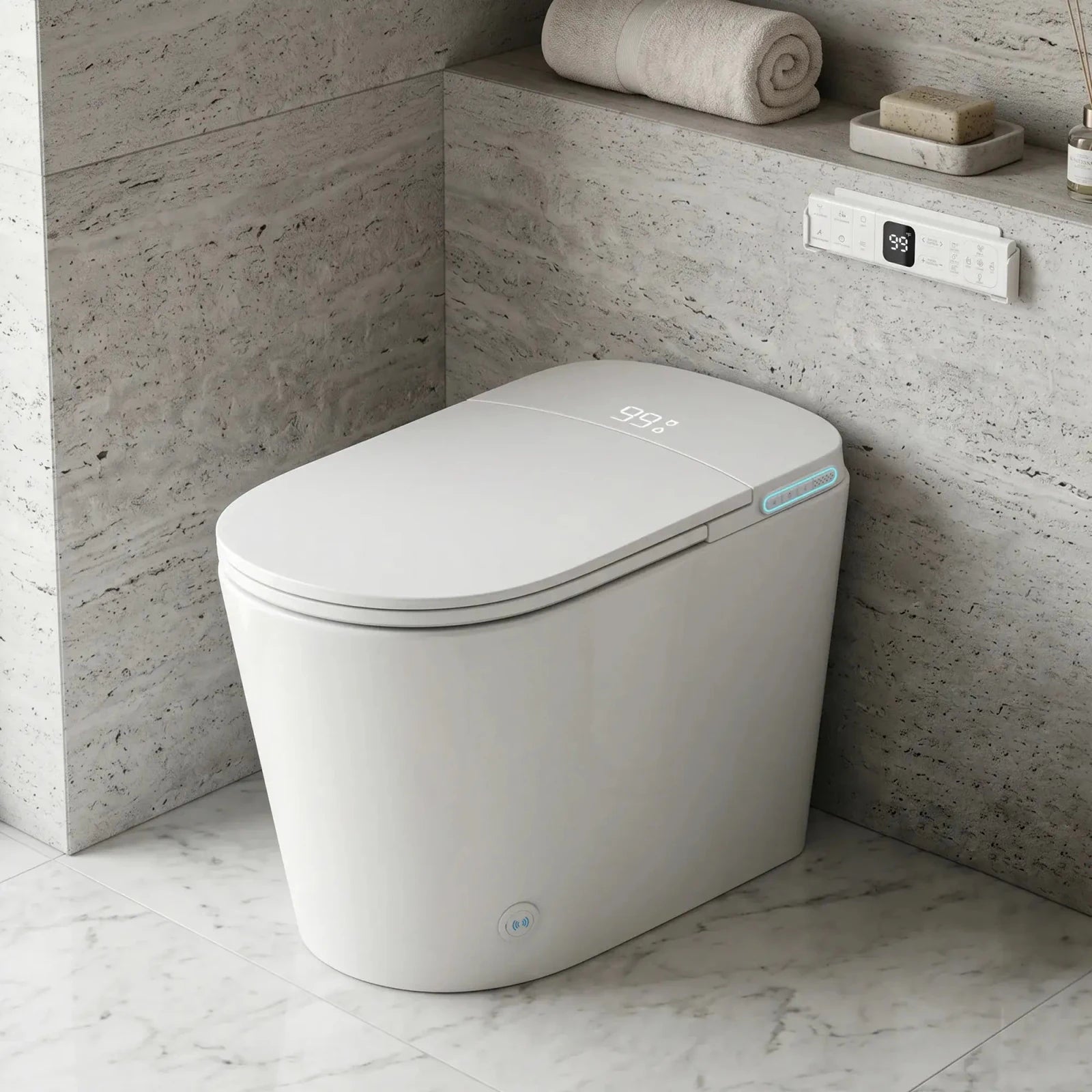
This matters especially when moving advice from a separate bidet seat to an integrated smart toilet. Their water connections and supply demands may differ. A filter that fits one seat's hose is not automatically appropriate for a whole toilet.
For example, the Lefton ST01 product page provides model-specific installation documents and water supply specifications. Those published requirements are a starting point, not approval for an arbitrary inline filter. Confirm any proposed accessory with Lefton before modifying the supply arrangement.
Also consider future cartridge changes before installation. A low purchase price is less attractive if replacing the filter requires awkward access or leaves the shutoff difficult to reach. Ask the installer to account for routine service, not only the initial fit.
Keep maintenance tied to the manual
A filter adds a maintenance task; it does not eliminate cleaning. Follow the cartridge maker's replacement schedule and any capacity limit, together with the bidet manufacturer's instructions. Keep the purchase date and replacement information somewhere you can find them.
Use only the cleaning products and procedures approved for the surfaces involved. Ceramic, plastic, seals, and electrical housings should not automatically receive the same treatment. A descaler that works on a showerhead is not necessarily suitable for a bidet's internal water path.
Do not pour vinegar or other descalers into the supply hose, tank, or nozzle assembly unless the exact model's instructions authorize that procedure. If an approved external cleaning does not resolve a problem, ask support for the next step instead of increasing the chemical strength or disassembling the unit.
Planning care for a Lefton smart toilet? Start with Lefton's User Manual & Videos, then contact the support team with your model, water-hardness result, and proposed filter. That gives you a clear answer about the setup you actually own.

Frequently asked questions
Does every bidet need a hard-water filter?
No. The decision depends on the water, the bidet's requirements, and any existing household treatment. Some models have inlet screens, but a screen is not proof of hardness reduction. Check the manual before adding another component.
Will a sediment filter stop calcium buildup?
A sediment filter is intended to trap particles. Dissolved calcium and magnesium require a treatment method designed for them. Choose according to a documented hardness or scale-control claim, rather than assuming a finer particle rating solves hardness.
Is an inline bidet filter the same as a water softener?
Not necessarily. Some cartridges use softening media; others use carbon or particle filtration. Whole-home softeners and small cartridges also have different capacities and service needs. Compare the actual treatment process and specifications.
How often should I change a bidet filter?
Follow the exact cartridge's interval and capacity instructions. There is no universal schedule for every filter and water supply. Keep a replacement record, and ask the manufacturer how your measured hardness affects its recommendation.
Can a filter fix a nozzle that already sprays poorly?
Not reliably. A new filter does not establish the cause or remove existing internal deposits. Follow the model's approved care instructions and have persistent problems assessed. Do not assume stronger chemicals or an extra cartridge will restore performance.
Share this
Popular posts





Leave a comment